Reimagining practices of consciousness raising
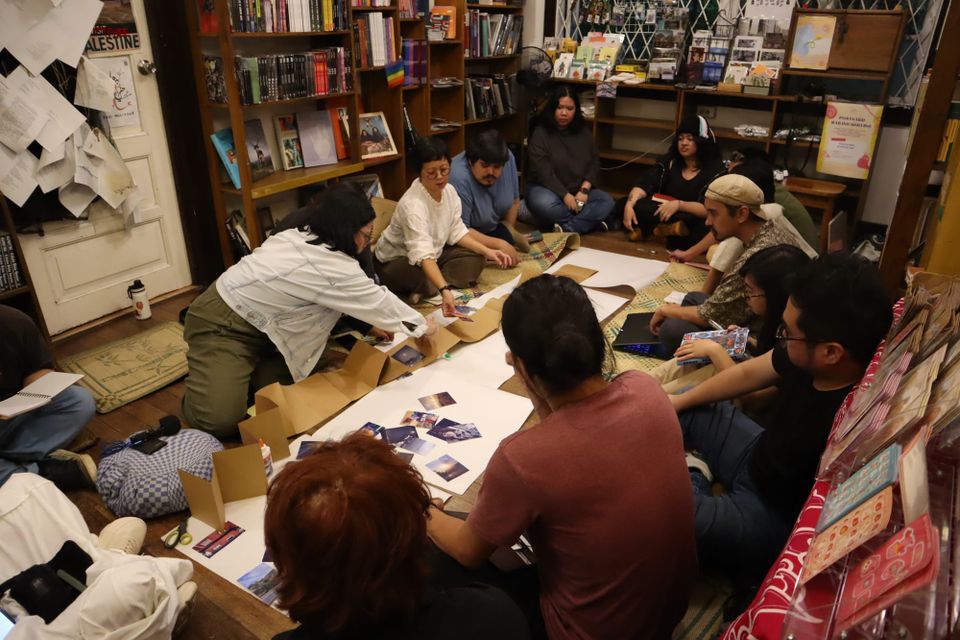
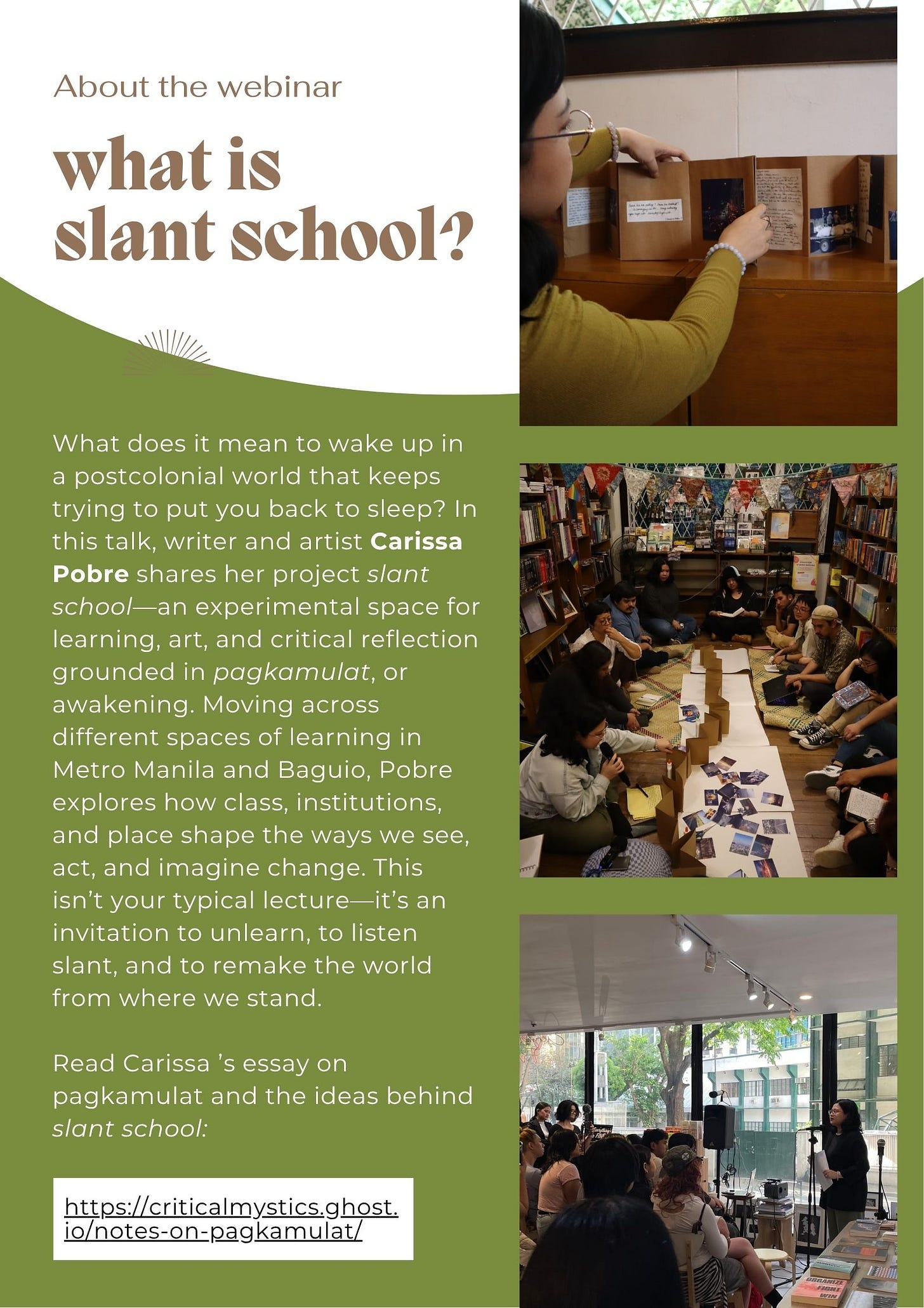
In the webinar, Pobre discusses the inspiration behind and insights from her performance art project centered on pagkamulat or awakening, called slant school. In the commentary, Mariano-Capistrano discusses how slant school frames and reimagines practices of consciousness raising.
“Paano ka namulat?”—the question that Carissa Pobre poses to us in slant school—can be viewed from different philosophical angles. For instance, we could view it from an epistemological one and think of “paano ka namulat?” as a question of how one comes into awareness and arrives at knowledge of injustice; or from an existential phenomenological angle, examining one’s experiences of pagkamulat to come to a better understanding of pagkamulat itself. For my purposes today, however, I want to view it as an intervention in social philosophy, more specifically on questions of social justice and how to change unjust social structures. I feel that viewing this question from this angle does justice to the polysemic meaningof pagkamulat as not only awareness and knowledge of injustice, but also as a movement to act against injustice—a meaning that is lost in translation into English or hidden from view from other philosophical angles. (This is not to say that the epistemological view is not important—it is, but I have chosen to not focus on it today.)
The question of how to change a social structure that is unjust is one that has haunted philosophy for centuries, even predating Marx’s famous statement that “philosophers have only interpreted the world in various ways; the point is to change it” (1845/1969). In the last couple of decades, women philosophers have taken on the challenge of this question, of how to change an unjust social structure (Cf. bell hooks, Iris Marion Young, and more recent critical social theorists like Sally Haslanger, Maeve McKeown, and Alasia Nuti). Many of them have arrived at similar insights: that practices of consciousness raising allow spaces for the critique of dominant ideologies, and that these practices and spaces are where people become aware of injustice and are often the seedbeds of movements for change.
Women philosophers have taken on the challenge of this question, of how to change an unjust social structure.
As Sally Haslanger writes in her 2021 article “Reproducing Social Hierarchy (or Not!)” a crucial aspect of acting against unjust social structures is becoming aware of how ideologies have not only limited our perception of the injustice but have also perpetuated injustices by our mere participation in these ideologies. As she states, “if we, ourselves, may be in the grip of an ideology, how can we judge what is emancipatory?” (2021, 195). Thus it is important to cultivate spaces and practices that allow for this degree of shared self-examination and self-criticism.
What could such emancipatory practices look like? What kinds of experiences and activities create these spaces of critique? It is important to highlight how these emancipatory practices are distinct from our accustomed academic practices of theorizing about justice. As Haslanger notes, “We do not need to know what justice is or have a complete moral theory to engage in social critique. We can begin with knowledge of (an) injustice.… What counts as ideology is a matter of the injustice of its effects and the (bad) values it promotes/embodies, so it focuses on identifying injustice and harm” (2021, 197).
In her work, Haslanger deliberately makes her description of consciousness raising a broad and expansive one, because consciousness raising arises from, and itself is, a social practice. Social practices in turn emerge from specific societies, histories, and cultural contexts, and from specific contexts of structural injustice. What she does end up describing are, at best, effects or outcomes of practices of consciousness raising. She writes,
Consciousness raising is a collective activity—done with others—and prompts a paradigm shift in one’s orientation to the world. This includes a shift in what facts become accessible, our interpretation of them, and what responses are called for. It is not easily reversed. The experience of such a paradigm shift is powerful, but its adequacy or warrant is not guaranteed. If a movement is to be built on such a paradigm shift, and if movements are to make warranted claims against others, then we need to think more about the conditions under which consciousness raising provides knowledge, and whatsort of knowledge it provides (2021, 199).
At this point, I hope we can begin to see the relevance of Haslanger’s work to Carissa’s presentation this afternoon: slant school is a continuing experiment in reimagining and developing practices of consciousness raising in the context of Philippine art practice. Slant school is not intended to replace or supplant existing practices of consciousness raising that exist in Philippine society, but rather to create new practices and foster new spaces in light of, and responding to, new social conditions and emerging social practices that accompany the ideologies that structure Philippine social life. It is one way of creating spaces of critique and resistance, but is not the only way, and is not the sole answer to the question of how to change a social structure.Our history as a country has already shown us that art, especially literature, has been responsible in the past for creating spaces for ideology critique, paradigm shifts, and movements for change—I need not enumerate the historical examples here. In just one example of continuing this tradition of literature as a site of ideology critique, earlier today, the Literary and Cultural Studies Program of the university I work for hosted 5th Edel Garcellano Conference on Committed Writing Now. I should note, however, that this conference is still in an academic context. Moreover, the term “consciousness raising” itself, in my process of thinking at least, is something that I first associate on impulse with images of voters’ education, formal programs often (though not always) associated with middle class ideals of electoral politics. Of course this is a shallow, first level mental association, yet it is indicative of the need to expand my notions, our notions of what practices can become sites of consciousness raising.
What further interests me in slant school is its explicitly articulated relationship with (and against) the practices and constructs of formal education.
What further interests me in slant school is its explicitly articulated relationship with (and against) the practices and constructs of formal education in which we all participate. It offers, in my opinion, a way of interrogating and critiquing our formal educational system in the Philippines that has slowly become thoroughly market-oriented, viewing its function as purely one of fulfilling the global market’s demands for skilled laborers and workers.
Where has this paradigm of education brought us? The Philippines is one of the biggest labor exporters in the world, but who has benefited the most and the least from this export? In the context of slant school, the question of paano ka namulat? thus becomes not just a broad intervention on the challenge of an awareness of and acting against unjust social structures, but also more specifically an intervention on the social structures that drive Philippine education. I speak here as someone embedded in that fundamentally unjust structure of the modern Philippine private university, struggling with the realities of the competing pressures of a “globalized,” “internationalized” university, the class inequalities of Philippine society that are reproduced by higher education, but also commitment to collective liberation, holding these complex and disparate realities together in one body, my body.
I would like to end with a quote from Haslanger’s text that I think illuminates the role of slant school as well as the need forother practices of consciousness raising and ideology critique, tied back to my role and position as an educator. How do I incorporate the creation of spaces of ideology critique and consciousness raising in my own work? Is there a possibility of even doing so? Speaking for myself as an educator, acutely aware of the position I occupy in the complex, unjust hierarchical system of Philippine education, this passagecontinues to give me food for thought and action, and, hopefully, it does the same for you:
I believe that there is tremendous suffering that might be alleviated by material redistribution of capital (of all kinds),food, housing, healthcare, education, and such. The problem is that although redistribution is important, we must also address the fact that societies are systems that maintain themselves and their hierarchies. Systems accommodate perturbations; they are self-regulating and revert toequilibrium. So, if we are going to address durable inequality, we should not only engage in a transfer of resources but also facilitate structural change. Structural change requires a change of culture. On my account, structures are composed of networks of practices. We are socialized—interpellated as subjects—to participate in practices, embrace their values,identify with the roles they offer, and work together with others, as the practices dictate, to produce, distribute, maintain, and eliminate things taken to have value. As mentioned, a change in the material conditions will prompt some changes in ideology; but because the material conditions and cultural technē are deeply intertwined, sustainable change requires a change in both. So, education for social justice should teach skills and methods of ideology critique. This does not happen simply by encouraging diversity, equity, and inclusion (Haslanger 2021, 213).
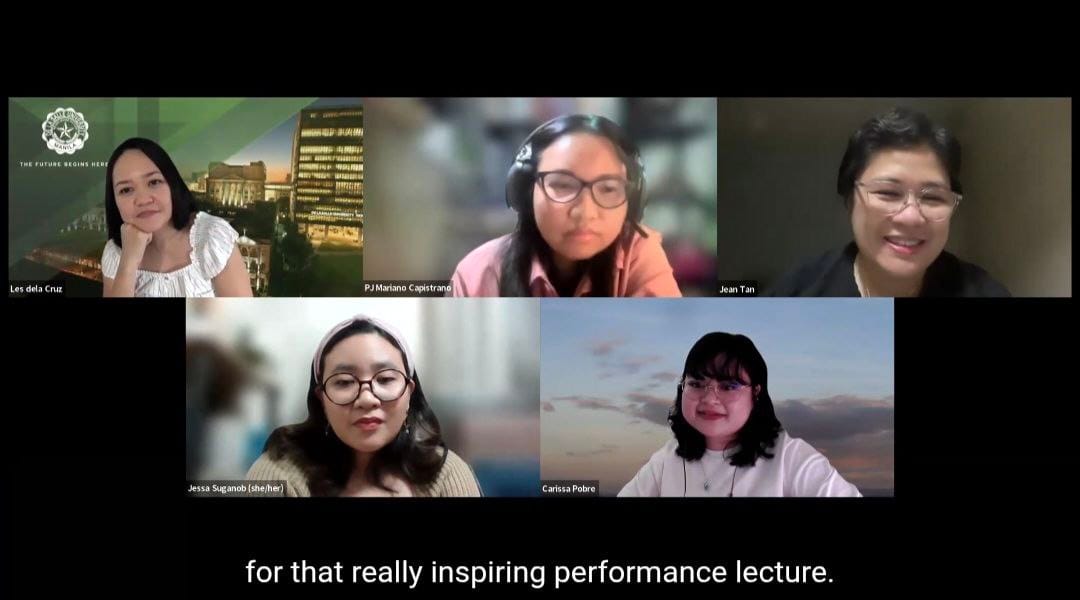
Watch the webinar on pagkamulat here.
Bibliography
Haslanger, Sally (2021). “Reproducing Social Hierarchy (Or Not!).” Philosophy of Education Society 77 (2): 185-222. doi: 10.47925/77.2.185.
Marx, Karl (1845/1969). “Theses on Feuerbach.” W. Lough, translator. https://www.marxists.org/archive/marx/works/1845/theses/theses.htm
Pobre, Carissa (2025). “Notes on Pagkamulat: Routes and Roots of Radicalism.” Essay/blog entry. https://criticalmystics.ghost.io/notes-on-pagkamulat/

Member discussion